Zillow Drops Out, Airbnb Remains Key for Consumer & Property Data
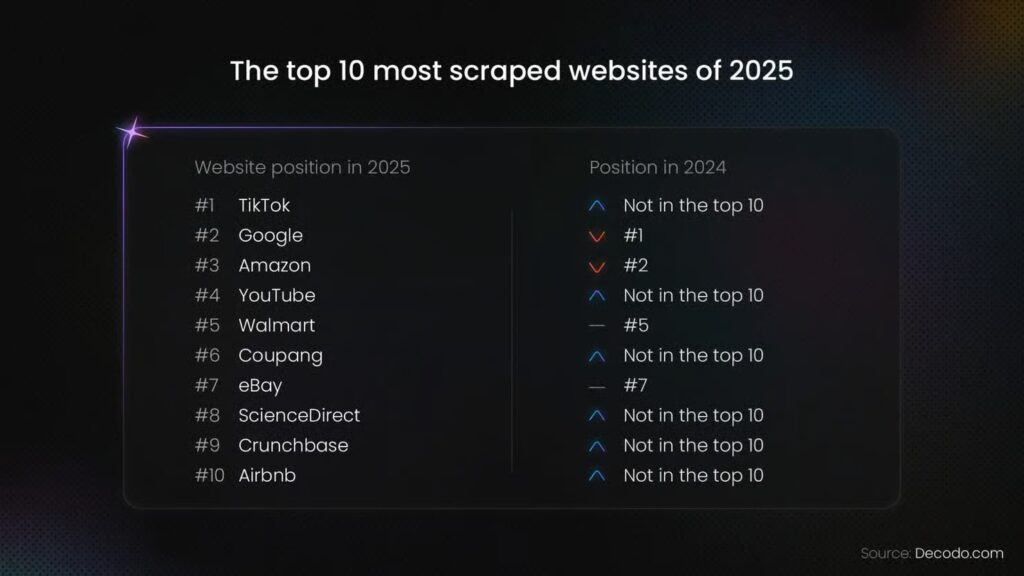
Decodo revealed that video and social media platforms are now the dominant data collection sources in 2025, accounting for 38% of all scraping activity. The report also highlights which platforms are most scraped and which have dropped out of the top 10 going into 2026.
Airbnb Remains a Top Data Source, Zillow Falls Out
Decodo’s latest report shows that video and social media platforms dominate web scraping in 2025, but property platforms still play a key role. Airbnb remains in the top 10, highlighting ongoing demand for real-time rental and listing data. Meanwhile, Zillow has dropped out of the top 10, signaling a shift in the types of consumer data being prioritized by AI and analytics companies.
TikTok Claims #1 Spot in Data Scraping, Surpassing Google
TikTok has jumped from outside the top 10 to claim the #1 spot. With over 1.5 billion active users and a discovery system powered by an advanced recommendation algorithm, TikTok’s rise highlights the AI industry’s growing focus on short-form video data. This shift reflects the growing importance of multimodal data, enabling companies to analyze behavior, sentiment, and engagement across multiple content types.
The Most Scraped Websites 2025:
| Rank | Platform | Platform Type | Most Commonly Scraped Data |
| 1 | TikTok | Video & Social Media | Video content and metadata |
| 2 | Search Engine | Search result rankings and featured snippets | |
| 3 | Amazon | eCommerce | Product listings and specifications |
| 4 | YouTube | Video & Social Media | Video metadata (titles, descriptions, tags, upload dates) |
| 5 | Walmart | eCommerce | Product availability and pricing |
| 6 | Coupang | eCommerce | Product listings and Korean market preferences |
| 7 | eBay | eCommerce | Auction results and final pricing |
| 8 | ScienceDirect | Academic | Research paper abstracts and metadata |
| 9 | Crunchbase | Business | Funding rounds and investment activity |
| 10 | Airbnb | Travel | Property listings and availability |
While Google has slipped from first to second place, it remains indispensable. As the primary gateway to information online, it fuels research, SEO, and AI initiatives with a vast, ever-evolving data ecosystem. Processing over 13.7 billion searches daily, Google offers real-time insights into global interests, consumer demand, and emerging market trends, making its data a foundation for business intelligence.
Amazon’s drop to third place (from second in 2024) reflects the growing diversity of digital data sources rather than a decline in influence. As the world’s largest online marketplace, Amazon remains a leader in product intelligence – from pricing and reviews to seller performance and inventory insights. Its data continues to be crucial for understanding online consumer behavior, competitive dynamics, and market trends.
Platforms that left the top 10
With the new targets climbing the list, a few websites dropped in position. Whether it’s due to the better alternative for data collection or the declining relevance of their content, their role in scraping priorities has noticeably decreased:
- TripAdvisor (previously #3) – dramatic change indicates that users are replacing review platforms with more comprehensive data sources that offer richer content variety and real-time insights.
- Craigslist (previously #5) – less relevant for modern LLM and AI agent training needs compared to other community forums, where the user activity is higher.
- Bing (previously #6) – businesses reduced data collection from this search engine and prioritized the dominant search engine for real-time data.
- Shopify (previously #8) – individual store scraping declined as businesses focus on major marketplace data.
- Lazada (previously #9) – replaced by bigger eCommerce marketplaces around the globe.
- Zillow (previously #10) – real estate data demand shifted toward broader business intelligence platforms.
Vaidotas Juknys, Chief Commercial Officer at Decodo, shares insights on what’s ahead for data scraping: “We’re seeing a clear move toward websites that have lots of different types of content instead of just basic info. The biggest reason for this shift is that everyone needs tons of varied, good-quality data to train AI chatbots, language models, and other smart tools. Companies operating in various industries are also realizing that the best insights come from mixing different kinds of content together – videos, text, images, and how people interact with certain platforms.”
The full report can be found here: https://decodo.com/blog/most-scraped-websites-2025#h2-scraping_trends_by_category