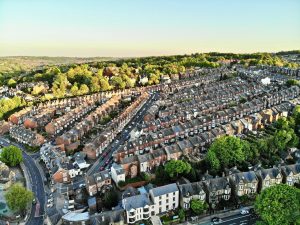
What homeowners need to know about adopted and unadopted roads

Sam-Alexander Lyon, Senior Associate in the property team at SAS Daniels Solicitors
Most people never think about the road they live on. They drive in, they drive out and assume that when a pothole appears, somebody at the council will eventually fix it.
For the majority of homeowners, that assumption is correct. But for a growing number, it is not. The gap between what people assume and what the law actually says is causing real difficulties and, in some cases, affecting the value of homes.
Sam-Alexander Lyon, Senior Associate in the property team at SAS Daniels Solicitors, explains what homeowners need to know about adopted and unadopted roads and the potential implications for property owners and buyers.
What is an adopted road?
An adopted road is one that the local highway authority has formally taken on.
From the moment of adoption, the authority has a legal duty to maintain the road under Section 41 of the Highways Act 1980. This includes repairing potholes, maintaining drains, providing lighting, gritting the road in winter and clearing litter.
The vast majority of roads in the UK are adopted. The road outside your local shop, the high street and the cul-de-sac on a fifty-year-old housing estate are likely to be adopted.
What is an unadopted road?
An unadopted road has not been taken on by the local highway authority.
The public may still have a right to use it, but the council has no general duty to maintain it. Instead, responsibility for keeping the road in good order falls on the people whose properties front onto it.
If the surface breaks up, they pay. If the drains become blocked, they pay. If a streetlight stops working, they may have to arrange and pay for the repair.
The simplest way to think about it is this: on an adopted road, the council fixes the potholes; on an unadopted road, you and your neighbours do.
What surprises many people is that you cannot tell which is which simply by looking. An unadopted road can be beautifully surfaced, with streetlights and pavements, and look identical to an adopted road nearby. The only way to know is to check.
How unadopted roads occur
Unadopted roads generally fall into two broad categories.
The first is the historic unadopted road. These are often Victorian or Edwardian roads, sometimes built by developers who went bust before completing the road to the required standard.
They can be found in pockets across the country, including parts of outer London, the South Coast and the North West. Residents may have inherited a problem that nobody currently living there had any role in creating.
The second is the new-build unadopted road. This is where the picture has changed significantly over the past 20 years and where much of the current political attention is focused.
A Home Builders Federation Freedom of Information exercise published in October 2025 found that, across more than 1,000 new developments of ten units or more built during the previous three years, only around one in ten had their roads adopted by the council. In around a third of local authorities, the figure was zero.
The Competition & Markets Authority also noted in its 2024 Housebuilding Market Study that around 80% of new homes sold by the 11 largest housebuilders came with estate management charges of some kind.
The phenomenon has acquired the nickname “fleecehold”, language which the Government itself adopted in its December 2025 statement announcing reforms.
How to check if your road is adopted
If you are unsure whether your road is adopted, there are three practical steps to take.
First, check the position with the highway authority. Every highway authority is required to maintain a List of Streets recording roads that are maintainable at public expense. Most councils now publish this online, or you can contact them directly.
Second, check your title deeds. Look carefully at rights of way and access. On an unadopted road, your right to drive up to your front door is not necessarily automatic; it must generally come from your title or another legal right. Long use does not always create a legal right.
Third, speak to your neighbours. Find out how repairs have been dealt with historically. Many unadopted roads operate through an informal system where residents contribute to a shared fund. This can work well until someone refuses to contribute. At that point, there may be no straightforward way to recover the money, and the burden can fall on those prepared to pay.
If these checks raise questions, it is better to take legal advice before a problem arises.
What does this mean for buyers?
For someone buying a new-build property, the position is particularly important.
Before making an offer, ask the developer:
Will the roads on this estate be adopted by the council?
If so, when, and is there an agreement with the council backed by a bond?
If not, who will manage the roads, what will it cost each year and who decides whether the charge increases?
Can I see the management company documents before I commit?
A reputable developer should be able to answer these questions. A reluctance or inability to do so is itself useful information.
Your conveyancing solicitor should investigate these issues as part of their due diligence. However, as the buyer, you are entitled to ask questions yourself, and the earlier you do so, the better.
What if the road never gets adopted?
If a road remains unadopted, three consequences are particularly important.
First, you may pay an annual charge to a management company for as long as you own the property, and that charge may increase over time.
Second, major works can result in one-off bills potentially running into hundreds or thousands of pounds.
Third, when you sell, some buyers and lenders may ask additional questions about private estates that they would not ask about properties on adopted roads. This could affect saleability and, potentially, value.
The council tax misconception
A common question is: “If I pay council tax, surely the council has to maintain my road?”
The legal answer is no. Council tax is not a charge specifically for road maintenance.
The duty to maintain adopted roads under the Highways Act 1980 is owed to road users generally, regardless of whether they pay council tax in the area. Crucially, that duty applies to adopted roads. On an unadopted road, the council has no general maintenance duty, regardless of how much council tax you pay.
There is, however, an obvious concern for residents on private estates. They pay council tax at the same rate as their neighbours on adopted-road streets, but may also pay estate management charges for services that, elsewhere, the council would provide.
The CMA highlighted this issue in 2024, and the Government has accepted that the position can be unfair.
Part 5 of the Leasehold and Freehold Reform Act 2024 will, once commenced, give freehold owners on managed estates a right to challenge the reasonableness of estate management charges, broadly mirroring protections that have long existed for leaseholders.
A Government consultation on bringing those provisions into force closed in March 2026, with secondary legislation expected to follow. Until the provisions are commenced, however, homeowners cannot rely on those new protections.
A word of advice
Almost every issue discussed here depends on the individual property. The title deeds, local authority search, whether there is a Section 38 agreement in place, and the terms of any estate rent charge can all affect the legal position.
The law in this area is changing, with the direction of travel towards greater transparency and more rights for residents. In the meantime, the basic rule remains: know what you are buying, understand what you own and take advice when you need it.
The content of this article is general guidance only and does not constitute legal advice. For advice, relevant to your own circumstances, please contact Sam-Alexander at the SAS Daniels Chester office on 01244 305 900 or visit www.sasdaniels.co.uk