London’s flex market splits: serviced offices cut rates to drive take up while managed supply expands
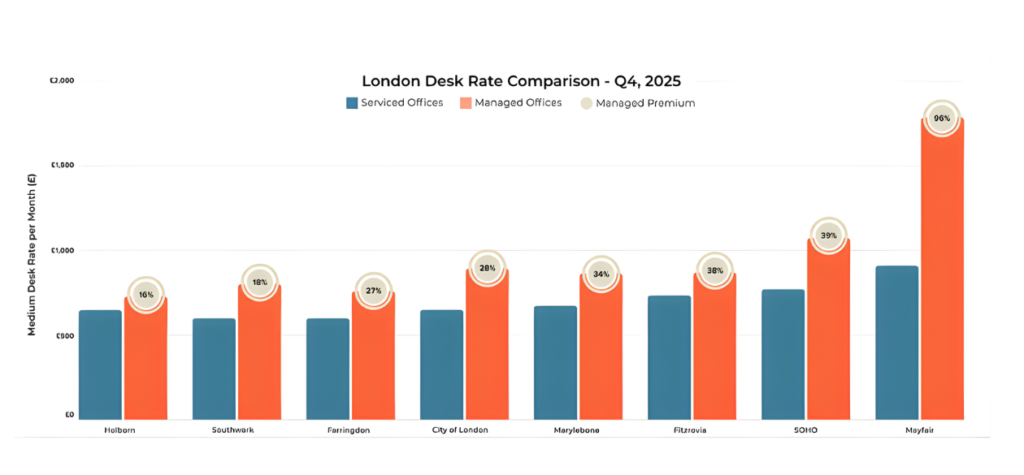
New data from the Rubberdesk Q4 2025 report reveals a significant split as serviced office operators are successfully driving take-up by reducing rates, while the Managed segment continues to expand its footprint, adding stock even as pricing softens only slightly.
A demand for low-cost space
Serviced office operators continued to compete largely on price in Q4 2025, pushing average desk rates down 4% year-on-year. These reductions are leading to take up, with stock levels contracting 7.3% year-on-year as operators filled existing inventory. The data reflects demand for low-cost, highly flexible solutions in a cautious economic environment.
Serviced offices are converting enquiries into occupancy, even if margins remain under pressure.
What are we willing to pay more for?
Managed office providers expanded their London footprint, with supply increasing 5.5% quarter-on-quarter and 2.5% year-on-year. The segment’s pricing dipped just 1% year-on-year.
Managed offices continue to command a £230 per desk pricing premium, which we see as evidence that occupiers will pay more for fit-out control, dedicated branding, and tailored terms.
Huge location variation
The managed premium varies enormously by location: from just 13% in Holborn to 96% in Mayfair. That spread tells a clear story about where the managed office model is most firmly established and commanding the highest premiums versus locations where the two products are still competing more closely on price.
Central London’s serviced office market is shifting toward smaller teams. Space for 1–4 desks grew by 31% quarter-on-quarter, and 5–10 desk space grew by 17%. In contrast, all office sizes above 10 desks shrank. This trend, which has strengthened over the past year, shows that operators are focusing on the strongest area of demand: small teams wanting flexible, ready-to-use workspace. The drop in larger serviced units suggests bigger companies are moving instead toward managed offices or traditional leases. As a result, competition among operators is heaviest in the sub‑10‑desk market, where demand is high but pricing pressure is increasing.
Mayfair is in a league of its own. The managed rate of £1,787 is more than double the serviced equivalent – a clear reflection of the ultra-premium institutional-grade managed product that has entered the West End over the past year (managed rates there surged 47.4% YoY). Soho and City of London sit in the mid-range at 38–39%, while Holborn’s narrow 13% gap suggests either strong serviced positioning or managed offices that haven’t yet fully differentiated on pricing.
Diverging occupier needs
As London’s flex market heads into 2026, competitive pricing in the serviced segment is likely to maintain strong occupancy momentum, while the expanding managed sector continues capturing a growing share of the market. Both segments appear well positioned with serviced capitalising on affordability-driven demand, while managed serve occupiers seeking greater control and stability.
Rubberdesk’s VP of Growth & Analytics, Tom Petryshen comments, “The 40% rate premium managed offices command over serviced isn’t a luxury tax. Businesses are willing to pay for bespoke, branded workspace that reflects their identity and operational needs. The fact that managed rates held firm while serviced fell 4% amidst economic turmoil says a lot about where the market is heading.”
Rubberdesk CEO, Jim Groves, concludes, “If you’re running a team of 10 to 30 people and you haven’t tested the market recently, now is the time. Serviced operators are focused on filling smaller units, which means mid-size occupiers can command better terms than the headline rates suggest. At the same time, managed supply is expanding faster than it’s being taken up. Smart businesses should be playing both sides of that equation. They can get competitive pricing from serviced while using the managed surplus to negotiate on amenities and term flexibility.”