Should You Rekey or Replace Your Cylinder Lock?

Image: Freepik
Anyone who manages a rental property will eventually face the same question: Should you rekey or replace locks when something changes?
Landlords in York ask me this when tenants move out, keys go missing, or door locks haven’t been replaced in years. In these situations, understanding the difference between rekeying locks vs replacing them can help you safeguard your property and your tenants.
Below, I’ll explain how Euro cylinder locks work, when landlords should change them, and how to decide whether to rekey or replace locks in your property.
Understanding how Euro cylinder locks work
Most modern rental homes use a Euro cylinder lock fitted within a multi-point door system. These work so that when a key is inserted and turned, a set of small pins inside the cylinder align, allowing the locking cam to move. This action engages the multi-point locking mechanism in the door.
The design is modular, so the cylinder can be removed without dismantling the door around it. And because the cylinder is its own part, you can either rekey the internal pins or replace the cylinder entirely when you need to.
So, a Euro cylinder lock is made up of simple components, but they play a major role in property security. As such, knowing when to service, upgrade, or change a lock cylinder is a key part of responsible property management.
Why lock standards matter for rental properties
One issue I regularly come across is outdated Euro cylinder locks that no longer meet modern security standards.
These are vulnerable to a burglary method known as lock snapping, in which the lock is snapped to gain entry to a property. According to home security experts, 27% of burglary cases involve locks being forced open, too, which is much more common with outdated locking systems.
If your rental property has locks installed from more than ten years ago, rekeying or replacing them is something you should be seriously considering. Door lock security technology has vastly improved over the last decade, and having outdated locks significantly increases the likelihood of lock snapping, picking, and bumping.
But how do you decide between rekeying and replacing your Euro cylinder locks?
When rekeying locks is the right choice
Rekeying changes the internal pin configuration of a lock so that the old key no longer works. In a nutshell, the existing cylinder stays in place, but a new key is needed to lock and unlock the door.
Rekeying locks vs replacing them is often appropriate when the lock itself is still modern and secure. For example, many landlords rekey locks when tenants move out, but the hardware is under ten years old. This prevents previous tenants from accessing the property and avoids unnecessary replacement costs.
Another common situation is when keys have been lost. Rekeying quickly removes the risk that someone could use the lost keys to enter the property. It can also be useful when creating a keyed-alike system, where one key opens several doors within a property.
However, rekeying is rarely recommended if the cylinder itself is outdated or damaged. In these cases, replacement is the better long-term option for landlords.
When you should replace locks instead
There are several situations where replacing the cylinder lock is the safer option. The most common is age because Euro cylinder locks wear down over time. As a result, internal springs weaken, pins stick, and keys become harder to turn. So, as a general rule, if your lock is ten to fifteen years old, replacement is usually the right move.
Security is another reason, as older cylinders often lack anti-snap protection. Upgrading to a modern TS007 or Sold Secure-rated cylinder improves security immediately, as these options have anti-snapping features included as standard.
Break-ins or attempted forced entry are another reason for a cylinder lock to be replaced. Even if the lock still works, internal damage may cause it to fail later.
Many landlords also replace locks when they buy a new property. You never know how many spare keys may still exist, so installing a new cylinder lock guarantees only the right people have access.
Why lock security matters for landlords
Good door security is one of the simplest ways to reduce burglary risk. This is largely because there were 245,284 burglaries reported in England and Wales in 2024/2025, and properties fitted with outdated or vulnerable door locks are easier targets.
Upgrading an old cylinder lock to a modern anti-snap model is also a relatively inexpensive improvement that significantly increases security for both landlords and tenants.
Step-by-step guide: how to change a lock cylinder
One reason Euro cylinders became so widely used is the simplicity of replacing them. For landlords comfortable with basic DIY, learning how to change a lock cylinder can make property preparation faster between tenancies. However, those with multiple properties may want to call a locksmith instead.
The process for changing a lock cylinder looks like this:
- Remove a retaining screw on the edge of the door
- Align the key to release the cam
- Slide the cylinder out
- Insert a replacement.
A crucial part of the process is choosing the correct size cylinder, so it sits flush with the door handle. Cylinders that protrude from the door are easier for burglars to break.
It’s also important to choose the correct cylinder in the first place. I usually recommend one of the following options:
- TS007 three-star-rated cylinders
- SS312 Sold Secure Diamond-rated cylinders.
Both offer protection against common forced entry methods, meet British standards, and are therefore home insurance compliant in the UK.
How to maintain your cylinder lock properly
A huge issue that causes lock problems is poor maintenance. For starters, many people reach for WD40 when a lock becomes stiff, but this leaves residue inside the mechanism that attracts dust and eventually clogs the internal pins.
A better option is using lubricants designed for lock mechanisms, such as GT85 or silicone spray. Both of these keep the cylinder operating smoothly without causing any buildup inside the lock.
Routine maintenance by a locksmith can also extend the life of a cylinder lock and prevent unnecessary replacements down the line.
When the issue isn’t the cylinder
Sometimes a door problem is mistaken for a faulty cylinder lock. If a door handle won’t lift properly or the key is difficult to turn when the handle is raised, for example, the problem might be the gearbox of the multi-point locking system, rather than the cylinder.
If this is the case, replacing the cylinder will not solve the issue. Instead, you’ll need to call in a professional locksmith to fix the gearbox mechanism.
Rekeying locks vs replacing them: a simple way to decide
For most landlords, the decision comes down to three questions.
- Is the installed lock modern and secure? If yes, rekeying is probably enough.
- Is the cylinder older than ten years or lacking anti-snap protection? If so, replacement is safer.
- Has the lock been damaged, forced, or compromised? If yes, replacing the cylinder lock is highly recommended.
Because Euro cylinders are relatively inexpensive, many landlords choose replacement for peace of mind alone.
How to change a barrel lock
Below is a simple graphic showing how to change a barrel lock step by step. It demonstrates how the cylinder is removed, aligned with the key, and replaced with a new unit.
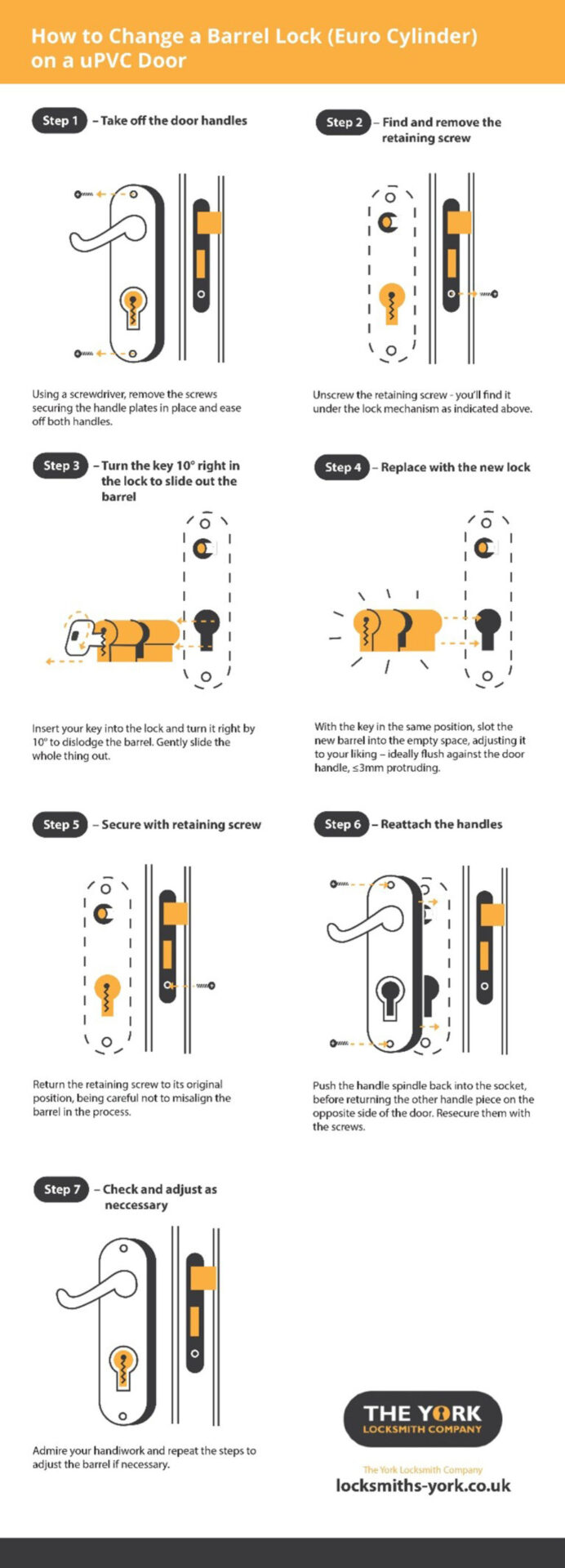
This is usually a quick job when the correct cylinder size is used. However, if you aren’t comfortable with DIY, it’s always a good idea to call a qualified locksmith.
Final thoughts
In summary, if a cylinder is modern and secure, rekeying may be perfectly suitable. If it’s older, worn, or vulnerable to attack, replacing the lock is usually the better choice. For landlords with multiple properties, checking door locks regularly and upgrading outdated cylinders is a straightforward way to protect both tenants and property.
And even though Euro cylinder locks are designed to be simple to maintain and replace, they still need occasional upgrading to meet modern security standards. So, knowing when to rekey or replace locks is an important part of managing rental properties safely.