Social housing residents are in strong favour of renewable upgrades, new survey finds
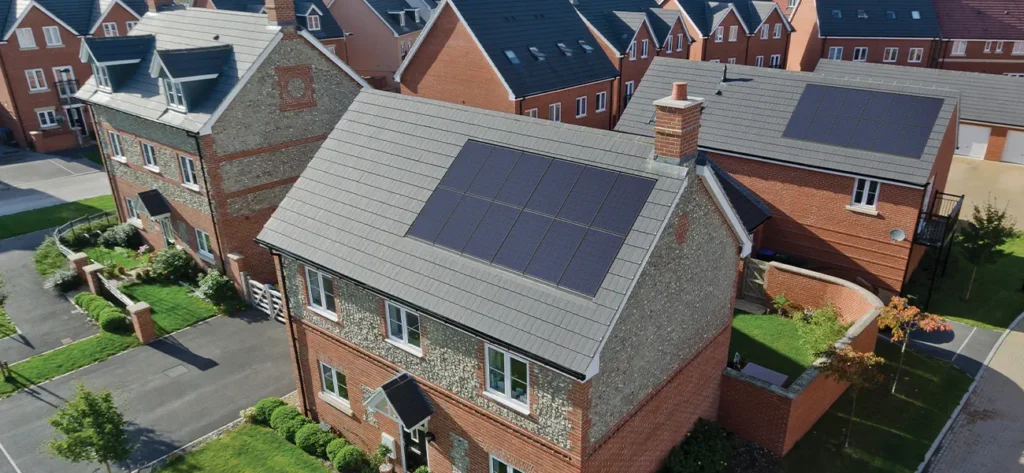
Roofing and solar expert, Marley, says councils and social housing providers could be saving money on property upgrades in the long run by supplying renewable upgrades for social housing residents.
Marley has surveyed UK adults living in social housing to determine attitudes towards renewable and eco-friendly energy sources like solar panels, heat pumps and EV charging facilities being installed on or in their homes.
It has found that the majority of social housing residents are in favour, with 3 in 5 (61%) interested in having solar panels installed. A further half of residents (54%) would like battery storage solutions to maximise the solar generated power too.
The regions most in favour, and “very interested” in solar panel installation on their home are; Wales, East Midlands, and then Yorkshire and Humber.
Charging points for electric vehicles (EVs) were least popular, with just 25% of social housing residents keen. But 40% – or 2 in 5 – social housing residents are interested in heat pumps being installed for their home.
“Solar panels are likely to be most popular amongst residents because there is greater education and long-standing evidence of their benefits and energy generation efficiency”, says Marley’s director of roof systems, Stuart Nicholson.
There are an estimated 4.5 million units of social housing stock across the UK, of which currently just 233,061 of these social houses have had solar panels installed to date, according to MCS data. With Marley’s study showing that 61% of these property tenants are in favour of solar panel upgrades and embracing solar power as a renewable energy source, it equates to 2.75 million homes.
Stuart adds: “Some of these properties will be flats, but there could still be up to 2 million social housing homes that want, and could benefit from, renewable upgrades. And this would be a significant proportion of the UK that could no longer have to face high electric bills and could better weather the cost of living crisis and fuel poverty issues with savings made from solar.”
Marley believes that these property upgrades could be made to social housing stock during refurbishment projects; and doing so would help residents financially at the same time.
Stuart comments on the study: “Currently some local authorities and social housing provider teams unintentionally work in silo. Meaning that renewable teams that contact us for installations may not realise that refurbs have already taken place on that property. Or solar is being installed on roofs at the end of their life span, meaning the solar panels will need to be removed while the roof is retiled, which is adding unnecessary costs and is not good value for money for councils. Working in conjunction – with the overarching goal being to create more eco-friendly homes in the UK – will mean more social residents have access to renewables and budgets can be more efficiently utilised in the process. The demand is certainly there as society embraces renewables, so social housing residents should have equal access.”